
Search behavior has changed permanently. Millions of people now ask ChatGPT, Claude, Gemini, and Perplexity for product recommendations, comparisons, and buying advice instead of typing a query into Google and scrolling through ten blue links. If your brand doesn't show up in those AI-generated answers, you're invisible to a rapidly growing share of your potential customers — no matter how well you rank in traditional search.
This shift has given rise to a new category of software: the AI search visibility tool. These platforms monitor, measure, and improve how often a brand is mentioned or cited by AI assistants, while also strengthening the traditional SEO signals that make a website easy for both humans and machines to understand. In this article, we'll break down what AI search visibility tools do, why they matter now more than ever, and how to choose one that actually moves the needle.
What Is an AI Search Visibility Tool?
An AI search visibility tool is software designed to help businesses understand and improve their presence inside AI-generated answers — the responses produced by large language models (LLMs) like ChatGPT, Claude, Gemini, and Perplexity, as well as AI Overviews in Google itself.
Unlike traditional rank trackers that only measure position on a search engine results page, these tools focus on a different question: does the AI actually mention my brand when someone asks a relevant question?
Most AI search visibility tools combine several capabilities:
- Citation tracking — monitoring whether and how often your brand appears in AI-generated responses across different assistants
- Content gap analysis — identifying topics and questions where competitors are cited but you aren't
- Crawlability auditing — checking whether your site's structure, metadata, and technical setup allow AI crawlers to access and understand your content
- Structured content generation — producing content formatted in a way that LLMs can easily parse, summarize, and cite
- Backlink and authority building — since AI models weigh third-party validation heavily when deciding which sources to trust
This is the discipline often called Generative Engine Optimization (GEO), a term coined by researchers studying how content ranks inside generative AI systems rather than classic search engines. It sits alongside traditional SEO rather than replacing it, because Google's own AI Overviews still rely heavily on indexed, well-optimized web content as source material.
Why AI Search Visibility Matters Right Now
The numbers make the urgency clear. Search behavior is fragmenting across multiple AI-powered surfaces, and each one has its own rules for what gets cited.
Consider how differently these platforms surface information:
| Platform | How It Surfaces Content | Key Ranking Signal |
|---|---|---|
| Google AI Overviews | Summarizes top-ranking indexed pages | Traditional SEO + structured data |
| ChatGPT (with browsing) | Pulls from live web sources and training data | Authority, clarity, freshness |
| Perplexity | Cites sources inline with links | Content structure, direct answers |
| Claude | Synthesizes from provided or browsed sources | Semantic clarity, factual precision |
| Gemini | Integrates Google's index and Knowledge Graph | Entity recognition, structured markup |
Because each of these engines works differently, businesses relying on a single SEO strategy built purely for Google's classic search results are leaving visibility on the table across four or five other high-intent discovery channels.
Analysts at Gartner have projected that traditional search engine volume will decline as more users adopt conversational AI for research and purchase decisions. Meanwhile, publishers and marketers tracking referral data have noted measurable increases in traffic originating from AI assistants, even though that traffic is currently smaller in raw volume than classic organic search. The direction of travel is unambiguous: AI-driven discovery is growing, and early movers are capturing outsized citation share before the space becomes as competitive as Google search is today.
How AI Assistants Decide What to Cite
To improve your visibility, it helps to understand what these models actually reward. While each AI assistant has proprietary methods, research and observed patterns point to a consistent set of factors:
- Clear, direct answers near the top of content. LLMs favor pages that state a conclusion plainly before elaborating, rather than burying the answer under long preambles.
- Structured formatting. Headers, bullet points, tables, and numbered steps are easier for models to parse and extract than dense paragraphs.
- Demonstrated expertise and freshness. Content published or updated recently, with specific data points and named sources, is more likely to be trusted.
- Crawlable technical infrastructure. If an AI crawler can't access or render your page, it doesn't matter how good the content is — it simply won't be considered.
- External validation. Backlinks, citations, and mentions from other reputable sites signal to AI systems (much as they do to Google's algorithm) that your content is trustworthy.
- Semantic and entity clarity. Using consistent terminology, defining your brand and products clearly, and marking up structured data (like schema.org) helps AI systems correctly categorize what you offer.
This is precisely why publications like Search Engine Land and Moz have started dedicating significant coverage to GEO tactics — because the mechanics of visibility are shifting even as many of the underlying SEO fundamentals, like authority and structure, remain the same.
Core Features to Look For in an AI Search Visibility Tool
Not all tools in this category are built the same way. Some focus narrowly on monitoring — telling you where you stand — while others, like FrontRank, go further by actively producing the content and technical fixes needed to improve your standing.
When evaluating a platform, look for these core capabilities:
- Multi-engine citation monitoring across ChatGPT, Claude, Gemini, and Perplexity, not just Google
- AI crawlability audits that flag issues like blocked robots.txt directives, missing structured data, or JavaScript-rendered content that AI bots can't parse
- Automated content calendars built around keyword and question research relevant to your niche
- Consistent publishing cadence, since both traditional SEO and GEO reward freshness and topical depth over time
- Backlink acquisition, because third-party citations remain one of the strongest trust signals for both Google and LLMs
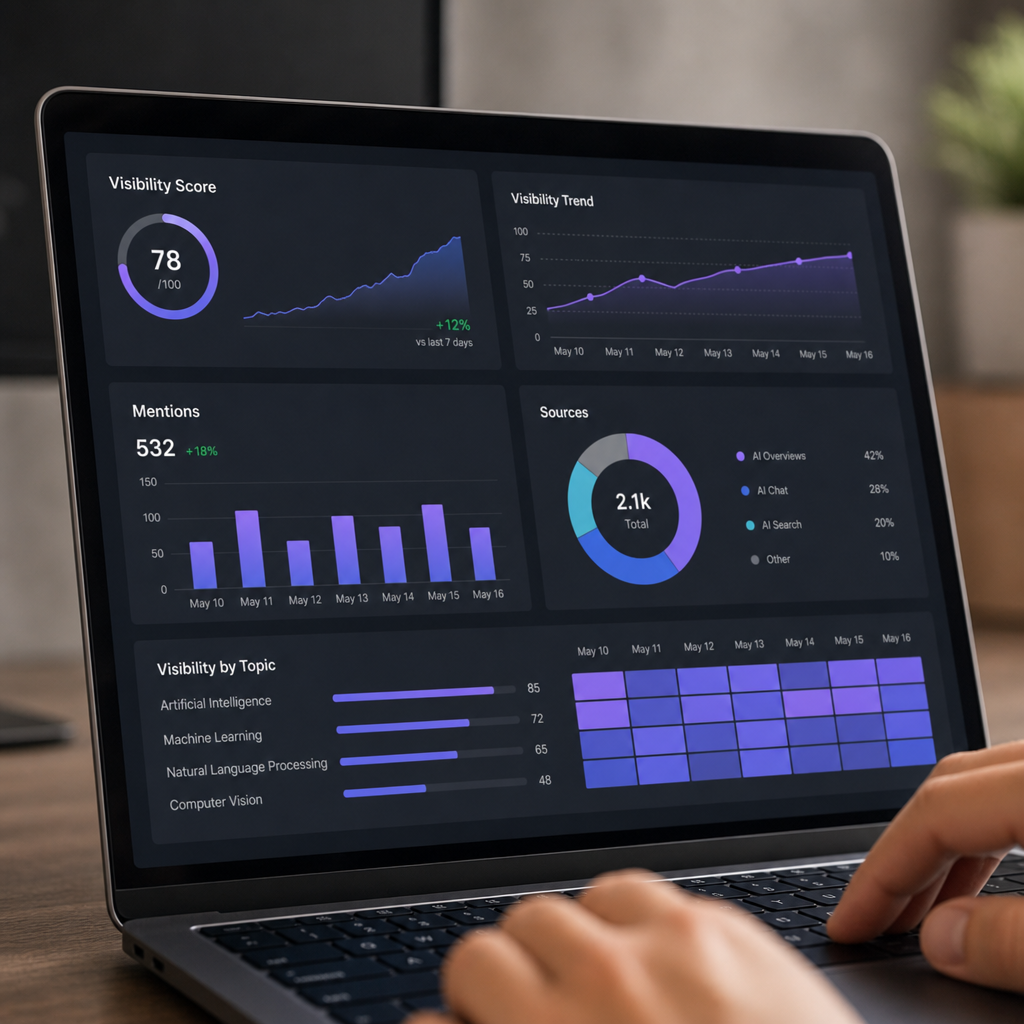
- Reporting and analytics that connect content output to measurable visibility gains
Manual SEO vs. AI-Native Optimization: A Practical Comparison
Many businesses still rely on a patchwork of freelance writers, part-time SEO consultants, and manual audits. That approach made sense when the only target was Google's algorithm. It becomes far less efficient once you're trying to optimize simultaneously for Google, Bing, ChatGPT, Claude, Gemini, and Perplexity.
| Factor | Traditional Manual SEO | AI Search Visibility Tool (e.g., FrontRank) |
|---|---|---|
| Content publishing frequency | Often sporadic (weekly/monthly) | Daily, automated |
| Optimization target | Google only | Google + major AI assistants |
| Keyword & topic research | Manual, time-intensive | AI-generated content calendars |
| Crawlability audits | Occasional, often overlooked | Continuous, automated |
| Backlink building | Separate outreach process | Built into the workflow |
| Cost structure | Multiple freelancers/agencies | Single subscription |
| Time to see results | Months, inconsistent | Weeks, with compounding gains |
The efficiency gap is the real story here. A solo founder or small marketing team simply cannot manually research, write, format, and distribute daily content while also auditing technical crawlability across five different AI platforms. That's the exact gap that automated AI search visibility platforms are designed to close.
How FrontRank Automates AI Search Optimization
FrontRank was built specifically to address the operational burden described above. Rather than asking founders, marketers, or agencies to manage AI visibility as one more manual task, the platform automates the entire pipeline from research to publication.
Here's how the workflow typically operates:
- Site audit for AI crawlability. FrontRank scans a client's website to identify technical barriers that prevent AI crawlers and traditional search bots from properly indexing content — including robots.txt misconfigurations, thin content, and missing structured data.
- AI-generated content calendar. The platform analyzes a business's niche, competitors, and target audience to build a rolling calendar of relevant topics and keywords, balancing search intent with question formats that align with how people actually query AI assistants.
- Daily article publishing. FrontRank produces SEO/GEO-optimized articles on a consistent daily schedule, ensuring the client's site continuously signals freshness and topical authority — a factor both Google and LLMs reward.
- Backlink integration. Each published article includes backlinks pointing to the client's site, compounding domain authority over time in a way that supports both classic rankings and AI citation likelihood.
- Ongoing optimization. As AI assistants and search engines evolve their citation behavior, the content strategy adjusts, so businesses aren't left running an outdated playbook.
The result is a system where a founder, eCommerce brand, or digital agency can maintain a serious content and backlink engine without hiring a full internal team of writers and SEO strategists. For agencies managing multiple clients, this kind of automation is particularly valuable — it allows a small team to scale AI-search-ready content production across many accounts without proportionally scaling headcount.

Common Mistakes That Hurt AI Search Visibility
Even businesses actively investing in content and SEO often undermine their AI visibility without realizing it. Watch for these pitfalls:
- Blocking AI crawlers unintentionally. Some sites configure robots.txt or firewall rules to block bots broadly, inadvertently excluding AI crawlers like GPTBot or Google-Extended along with unwanted scrapers.
- Publishing thin, generic content. AI models are trained to recognize substantive, well-sourced answers. Shallow, keyword-stuffed pages rarely get cited.
- Ignoring structured data. Schema markup helps both search engines and AI systems understand entities, products, and relationships on your site — skipping it leaves valuable context on the table.
- Inconsistent publishing. Sporadic content bursts followed by long silences signal low authority and reduce the likelihood of being treated as a fresh, trustworthy source.
- Neglecting backlinks. Content alone isn't enough; without external validation, both Google's algorithm and AI trust models are less likely to elevate your site as a citation-worthy source.
- Failing to answer questions directly. Content written for narrative flow rather than direct question-answering is harder for LLMs to extract and summarize accurately.
Avoiding these mistakes requires ongoing vigilance — another reason automated auditing, like the crawlability checks built into FrontRank's platform, has become valuable rather than optional.
Measuring ROI from AI Search Visibility Efforts
Because this category is new, many teams struggle to define what success looks like. A useful framework includes:
- Citation frequency — how often your brand appears in AI-generated answers for relevant queries, tracked over time
- Referral traffic from AI platforms — visits originating from ChatGPT, Perplexity, and similar tools, visible in analytics referral data
- Organic search rankings — since GEO and SEO fundamentals overlap significantly, improvements often show up in classic Google rankings as well
- Backlink growth — the pace and quality of new referring domains
- Content velocity — the volume and consistency of published, optimized content over a given period
Tracking these metrics together, rather than any single one in isolation, gives a more accurate picture of whether an AI search visibility strategy is working. Businesses that pair consistent publishing with technical crawlability fixes tend to see compounding gains: each new article adds another opportunity for citation, another backlink signal, and another indexed page reinforcing topical authority.
Getting Started With an AI Search Visibility Strategy
If you're building an AI visibility strategy from scratch, a structured approach works better than ad hoc content production. Consider this sequence:
- Audit first. Understand your current crawlability status and where AI bots may be blocked before investing in new content.
- Research questions, not just keywords. AI assistants respond to conversational queries, so your content calendar should reflect real questions your audience asks.
- Publish consistently. Aim for a steady cadence rather than sporadic bursts — daily or near-daily publishing compounds authority faster than occasional long-form pieces.
- Build backlinks alongside content. Content without external validation moves the needle more slowly.
- Monitor citations across platforms. Check how your brand appears (or doesn't) across ChatGPT, Claude, Gemini, and Perplexity on a recurring basis.
- Iterate based on data. Treat this as an ongoing process, not a one-time project — the AI visibility landscape continues to shift as models update.
For most founders, marketers, and agencies, executing all six steps manually and continuously simply isn't realistic alongside everything else on their plate. That's the gap automated platforms like FrontRank are designed to fill — combining audit, research, content generation, and backlink building into a single, ongoing system rather than a series of disconnected manual tasks.
Final Thoughts
AI search visibility is no longer a speculative trend — it's a measurable, growing channel that sits alongside traditional SEO as a requirement for any business that wants to stay discoverable. The brands that adapt now, by fixing technical crawlability issues, publishing consistent and well-structured content, and building the backlink authority that both Google and AI assistants reward, will be the ones showing up when customers ask ChatGPT, Claude, or Gemini for recommendations. FrontRank exists to make that transition manageable, automating the daily content production, keyword research, and crawlability auditing that AI search visibility demands — so businesses can focus on running their operations while frontrank.com handles the work of getting them cited and ranked.
Article written by FrontRank